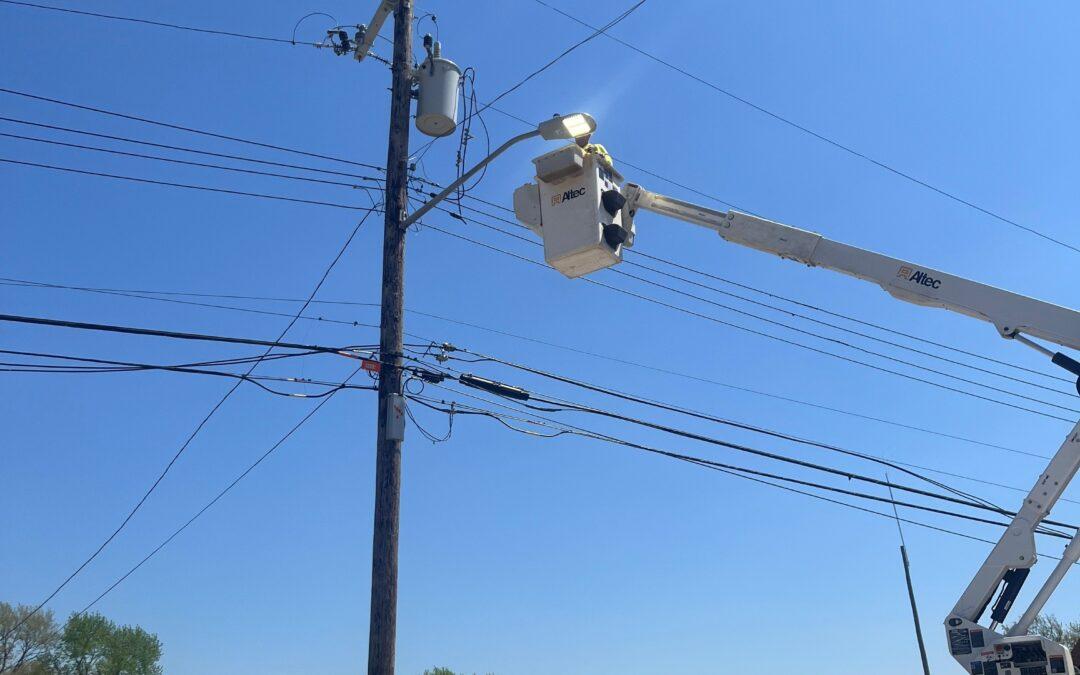
As DTE continues to modernize our company’s infrastructure, we’re installing new technology to transform how we light up streets across our communities! From regulatory alignment and strategic investment to field deployment, smart nodes are enabling a more data-driven, efficient and responsive Community Lighting system for our customers.
Smart nodes – intelligent control units equipped with sensors and network connectivity – are being deployed on streetlights to provide real-time visibility into system performance. These devices monitor light functionality, track circuit health and deliver data that allows for more precise and proactive maintenance.
Building a smarter foundation
Unlike traditional lighting systems, smart nodes enable each fixture to communicate directly with a centralized network. This tech gives DTE insight into outages, circuit performance and long-term trends to improve maintenance planning, warranty tracking, future upgrades and long-term infrastructure strategy.
“Smart nodes essentially make each streetlight ‘intelligent,’” said Ting Zhou, Community Lighting manager. “Instead of relying on someone to notice an outage, the lights can communicate with us in real time-so we can detect and respond to issues immediately.”
From concept to field deployment
According to Matt Valascho, expert engineer in Community Lighting, the process included a detailed evaluation of vendors and technologies to ensure compatibility with DTE’s existing systems and long-term scalability.
The team launched a pilot at the Western Wayne Service Center to validate real-world performance. This controlled environment allowed DTE to refine wiring configurations, confirm physical integration and test commissioning workflows before expanding into the field.
Pilot progress in Berkley
The Berkley pilot marks the first large-scale deployment of smart nodes, with installations underway across both cobra-head and colonial-style fixtures.
Stephanie Sharlow, principal analyst in Community Lighting, shared that 60 locations have been completed so far with approximately 160 remaining. The Berkley pilot is expected to wrap up in June with additional installations planned in Huntington Woods, Fraser and Fort Gratiot bringing an estimated 600 more smart nodes online!
Real-time visibility and future potential
One of the most impactful aspects of smart nodes is the immediate feedback they provide.
“The instant visibility is incredible,” Ting said. “As soon as a node is installed, it shows up on a digital map. We can remotely validate it and begin controlling it right away!”
With smart nodes reporting precise GPS locations, crews can more easily locate and service lights, reducing time in the field and minimizing unnecessary costs.
Even more powerful is the long-term data these nodes will generate.
“For the first time, we’ll know exactly where every light is and have detailed attributes for each asset,” Ting explained. “Over time, we’ll build a complete history that creates an AI-ready foundation driving a level of efficiency we haven’t seen before.”
Benefits for customers and communities
The implementation of smart nodes goes beyond operational improvements- it directly enhances customer experience!
With real-time monitoring, outages can be identified and addressed more quickly, often before they are reported. Additionally, smart nodes enable more precise energy tracking, helping ensure you are billed based on actual usage rather than estimates.
Looking ahead
As DTE continues to roll out smart nodes, this innovative technology is reshaping streetlighting into a smarter, more responsive system. With a clear strategy, strong regulatory alignment and early pilot success, the program is positioned to deliver long-term operational and customer benefits.
Smart Node attached to a light: